
Separate Reference Notes from Project Notes. Mixing evergreen knowledge with project noise is why search fails. Split them on purpose.
Why does search return sprint chatter when I wanted a definition?
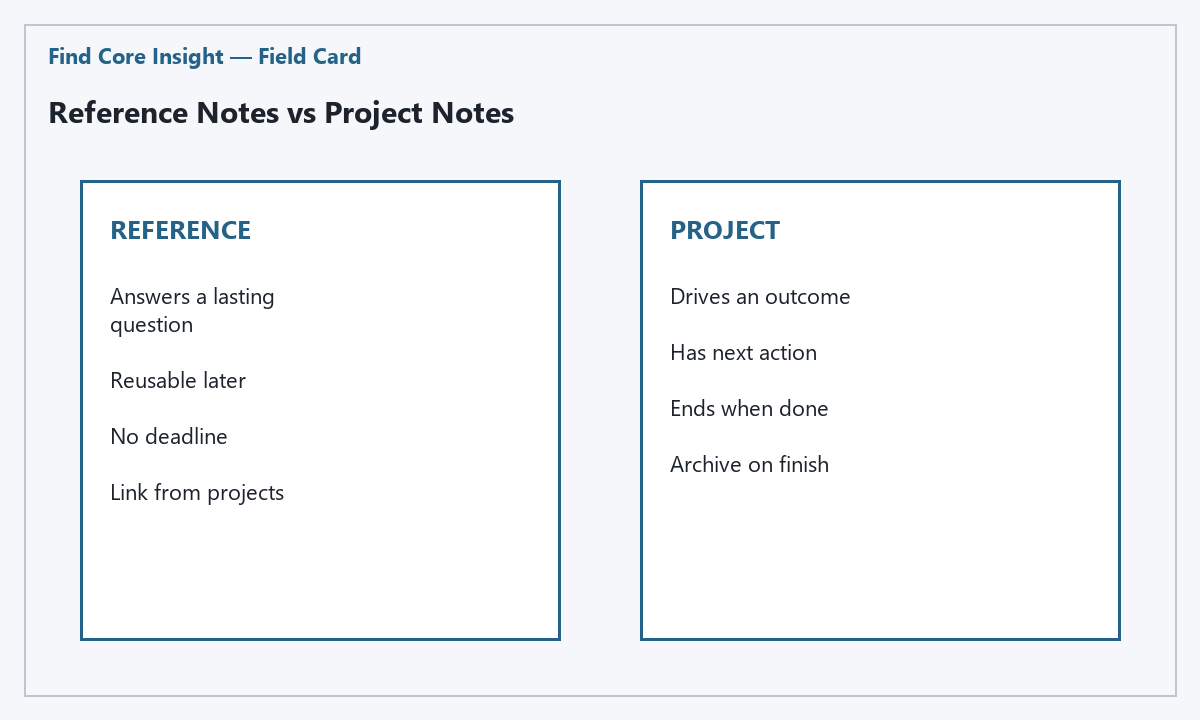
You stored reference facts inside a project note titled Q2 launch. Full-text search surfaced standup bullets and Slack paste-ins when you needed the pricing formula. Split on purpose: reference answers lasting questions; project drives an outcome with a deadline.
When those two live in one note, search returns noise. You open the wrong section under pressure and rebuild context from memory—the thing notes were supposed to prevent.
Teams share one drive and blame search. Often search works; notes lie about their type. Splitting is cheaper than buying a new tool.
Why does my project note feel like a novel nobody finishes?
Evergreen essays and meeting dumps live in the same file. The note grows because reference material keeps arriving mid-sprint. Fix: move stable facts to a ref note titled as a question—How we price pilot projects—and link from the project. Project notes should shrink as launch approaches, not swell.
Failure mode: documentation guilt—trying to save every Slack thread at project end. One harvested lesson beats fifty pages.
How do I name them so future-me retrieves them?
Reference: question titles—What breaks if we delay API v2? Project: outcome titles—Ship contractor onboarding by May 30. Avoid Misc. If you cannot classify at capture, leave the item in inbox until you can. Premature Misc folders are where notes go to become unsearchable with a clear conscience.
Which direction should links run?
Default project → reference. The project borrows truth; reference does not track every consumer. Bidirectional link spam recreates topic graphs without retrieval value.
When a project ends, harvest one lesson into reference in under ten minutes. Example: Lesson: vendor API docs lagged two weeks; add doc review to kickoff checklist. Collapse leftover project notes after harvest. Storage is cheap; attention is not.
How do I migrate a chimera note today?
Open the worst offender. Highlight evergreen sentences → paste into new ref note. Leave time-bound tasks in a slim project note. Delete the chimera. Timebox thirty minutes. Perfect migration is not required; searchable split is.
Do this for one note before redesigning the whole vault. One split teaches the naming instinct better than a taxonomy workshop.
What belongs in reference vs project at capture?
Ask before saving: Will this matter after the deadline? Yes → reference. No → project. If both, split before you save once. Mixed notes feel faster at capture and cost hours at search.
Reference notes hold definitions, policies, and stable how-we-do-X facts. Project notes hold next actions, blockers, and dated decisions tied to a ship date. Blurring them is the most common search failure we see in field reviews.
Case: a launch note contained both the customer-facing FAQ and sprint tasks. Search for pricing returned standup paste-ins. Split took twenty minutes; saved hours across the quarter when Finance asked the same question monthly.
FAQ-style check: is this note lying about its type?
If a ref note contains dated tasks, it is a chimera. If a project note contains only definitions, move them out today. If you hesitate, ask: Would I care about this paragraph after the ship date? No → cut and paste to ref. Yes → keep in project with a date on the bullet.
Chimeras feel efficient at capture because you only touch once. They tax every search until split.
Run the lying test on your ten most-opened notes this month. Split the worst chimera before adding any new structure. Structure without splits is wallpaper.
Mid-sprint control panel check: next actions, blockers with owners, dated decisions—everything else links to ref. Swelling project notes near launch mean chimeras returned; split again before ship week.
Harvest template — ten minutes at project end
When a project ships, open the project note once. Fill four lines:
- Outcome: what actually shipped
- Surprise: one thing that differed from plan
- Lesson: one sentence for ref
- Link: ref note created or updated
Archive the project note after harvest. If harvest takes longer than ten minutes, you are documenting guilt, not knowledge. The lesson line is the only mandatory field.
Example lesson: Contractor onboarding needs legal review at kickoff, not week two. That line saved a repeat on the next onboarding—not the forty pages of rehearsal notes.
Harvest is optional for failed projects too. One lesson on why it failed beats archiving blame threads nobody will read.
When Finance asks the same question twice in a sprint, split pricing facts to ref that day—repeat questions are split triggers, not annoyances.
Finance asks twice — split trigger
When Finance asked pricing formula twice in one sprint, that was the split trigger—not a taxonomy project. Ten minutes: ref note How we price pilot projects, slim project note with link. Third ask never happened.
Repeat questions from others are gifts—they tell you exactly which chimera hurts. Split that note before reorganizing folders.
Split triggers beat annual cleanups because pain is fresh and motivation is free.
Two note types, two questions
The split is a retrieval feature disguised as extra work. You are not organizing for aesthetics; you are organizing for the question you will ask in a hurry six weeks from now.
Start with the note you searched for three times last month and failed to find. Split that one today; let the rest wait.
Reference is for truth after the deadline. Project is for work before it. Mix them and you pay interest every search.
One chimera split teaches more than a folder reorganization. Start messy notes, not clean folders.
Project notes should shrink near ship date. If yours swell, reference is leaking in—split before the launch week scramble.
Finance asking twice is your split trigger. Answer the second ask with a ref link, not a third paraphrase from memory.
Harvest one lesson at project end—ten minutes max. The lesson line is the only mandatory archive; everything else may go.