Tomorrow’s first half hour will be spent reconstructing where today’s draft actually stopped. You’ll sift through open tabs, scan half-written notes, and try to remember the half-formed argument you were building before your last meeting ran 20 minutes over. That wasted time adds up fast, cutting into the deep work window you guard so carefully each week. A tiny, consistent end-of-day ritual eliminates that friction entirely, and it takes less than two minutes to complete.
Mornings that start by hunting yesterday’s place
Most knowledge workers lose between 15 and 25 minutes of productive time every single morning just reorienting to their unfinished work. This isn’t a failure of focus—it’s a failure of context setting. When you step away from a project mid-flow, even for 12 hours of sleep and personal time, the fine details of what you were doing and why you were doing it fade fast. A generic to-do list entry that says “work on client project” doesn’t fill in those gaps, so you end up re-reading pages of notes, scrolling through old Slack threads, and retracing your steps before you can do any actual new work. Illustrative example: A UX designer wrapping up a user testing report at 4:55 PM on a Thursday might leave a note that says “finish report” for Friday, but when they return the next morning, they have to re-watch 20 minutes of user interview footage to remember they were mid-way through documenting pain points with the checkout flow’s address verification step. That 20 minutes of reorientation could have been spent writing the actionable recommendations that move the project forward.
One written first line before the lid closes
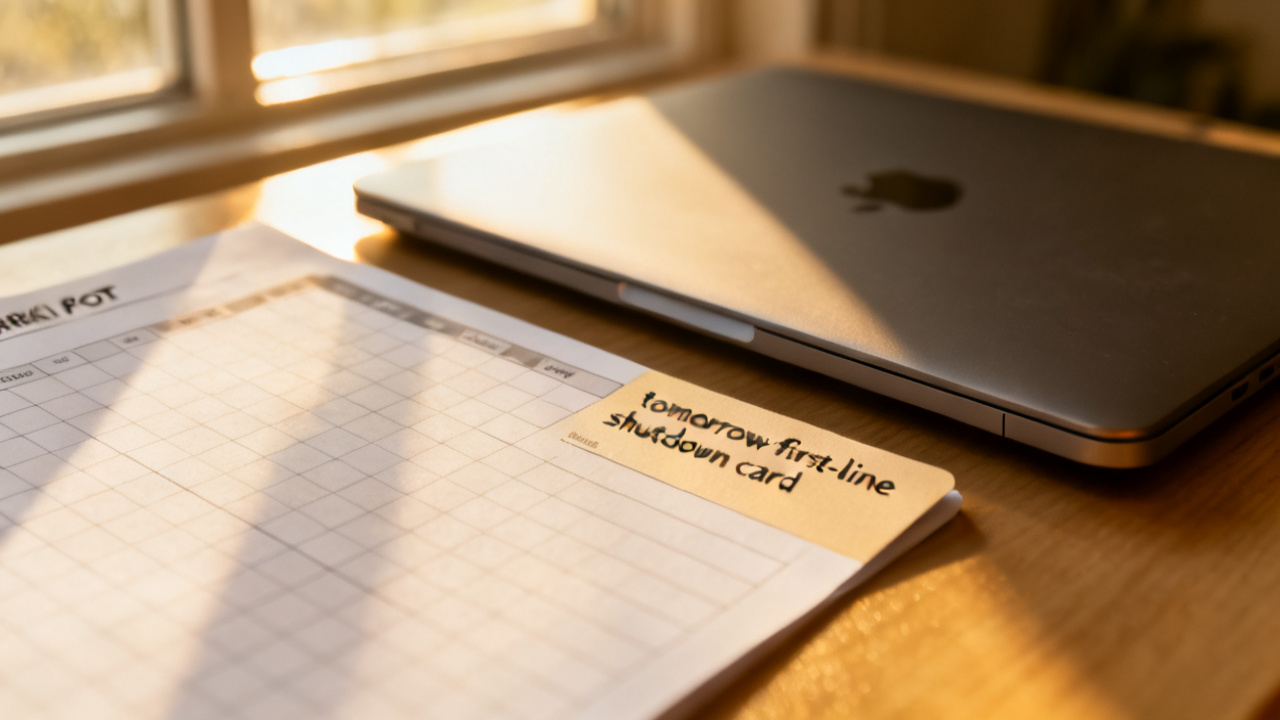
This ritual’s core is simple: before you shut your laptop lid and mark your workday as complete, you write one specific, actionable first line that tells you exactly what to do the second you sit down to work tomorrow. This line isn’t a vague task marker—it’s the exact first action you will take, no decision-making required. To make this even easier, you can use the reusable tomorrow-first-line shutdown card, a 4-field template you can fill out in 60 seconds or less at the end of each day:
| Section | Prompt | Example Entry |
|---|---|---|
| Project Context | What specific, named project is this line tied to? | Q3 B2B email nurture sequence rewrite |
| Exact First Action | What is the very first thing you will type/click/edit when you open this work? | Rewrite the subject line for the third nurture email to highlight the free case study download offer, instead of the generic product demo prompt |
| Supporting Access Link | Where is this work stored, no tab hunting required? | https://your-email-tool.com/drafts/38927-nurture-sequence-q3 |
| 1-Sentence Context Reminder | Why does this action take top priority tomorrow? | This sequence needs to be finalized by end of day Friday for the sales team to use for new lead follow-up next week |
You can save this card as a pinned note in your project management tool, a sticky note on your laptop lid, or a note in your phone, whatever is most accessible when you wrap up for the day. Find Core Insight’s internal teams use this template to cut down on morning context switching across remote and in-office roles.
Vague lines that do not start work
Not all first lines are created equal, and vague lines will leave you just as stuck as no line at all. A good first line removes all decision making from your first 60 seconds of work: if you have to ask “what does that mean?” when you read it the next day, it’s not specific enough. Common bad first lines include “work on the nurture sequence”, “finish the report”, “follow up with the client”, or “review feedback”. None of these tell you exactly what to do first, so you still have to dig for context to get started. Example timing: A vague first line like “update the blog post” can take 12 minutes of context hunting to turn into actionable work, while a specific first line lets you start editing in 10 seconds flat. The difference is entirely in the level of detail you include when you write the line, while the context of your work is still fresh in your mind.
Three nights of leaving a concrete first line
You don’t have to commit to this ritual long term to see results: test it for three consecutive work nights first, and measure the difference in your morning productivity. On the first night, you will likely forget to write the line until you are halfway out the door, or already on your couch after work. That’s fine: take 30 seconds to jot it down, even if it’s a little rough. On the second night, you will start thinking about your first line as you wrap up your last task of the day, so filling out the shutdown card will feel faster and more natural. On the third morning, you will sit down, open your shutdown card, and start working immediately, no tab hunting, no note re reading, no retracing your steps. Once you see how much time you save, you can expand the ritual to include first lines for multiple priority projects, if you want, or stick to just one line for your highest-priority task each day.
Shifts that start with a posted assignment board
This ritual works just as well for teams as it does for individual contributors. If you lead a team, you can adapt the shutdown card template to a shared “assignment board” (either digital, in your team’s Slack channel or project management tool, or physical, for in-office teams) where each team member posts their first line for the next day at the end of their shift. This eliminates two common team pain points: first, if a team member calls out sick unexpectedly, a teammate can pick up their highest-priority task immediately without having to dig through their files or inbox for context. Second, it cuts down on standup meeting time, because every team member already knows exactly what their first priority is, so standups can focus on blockers and collaboration instead of reciting task lists. For example, a customer support team member might post a first line that says “Follow up with Maria Garcia regarding her delayed equipment order ticket #82749, reference the shipping confirmation we received at 4:15 PM today” so if they are out the next day, another rep can handle the time-sensitive follow up without missing the promised window.
Tonight, before you close your laptop for the day, skip the long, generic end-of-day to-do list and fill out one entry on the tomorrow-first-line shutdown card for your highest-priority task. You’ll notice the difference the second you sit down to work tomorrow, no context hunting required.