A coworker’s “quick thought” is already a new document, and the sentence you were writing is gone. You were 22 minutes into a 45-minute deep work block focused on drafting a client project scope, and the detour has already pushed you off the rhythm you spent 10 minutes building. Even if you toggle back to the scope document immediately, the half-formed question about the team’s Q3 budget lingers at the edge of your attention, pulling your focus away from the line you left off mid-sentence. That’s where a physical paper parking lot cuts through the digital clutter that makes these small interruptions feel unmanageable, no fancy productivity apps or complex workflows required.
Find Core Insight editors
Interruptions that become new tabs mid-block
Most knowledge workers handle dozens of small interruptions over the course of a standard workday, and the vast majority of these are not time-sensitive enough to require dropping your current task immediately. The default response for most people is to either address the interruption right away, killing 10 to 15 minutes of flow time for a 30-second task, or open a new browser tab to “deal with it later.” These orphaned tabs pile up across your window, and every time you switch between applications to return to your core task, you catch a glimpse of the unhandled request, creating a low level of background stress that pulls your focus even further. Digital capture tools are often pitched as a solution to this problem, but they carry the same risk: opening your notes app to jot down a reminder can lead you to see an unread to-do item from three days prior, sparking another unplanned detour before you even get back to your original work. Even seemingly harmless interruptions, like a random idea for a side project, a reminder to pick up pet supplies on the way home, or a Slack ping about next week’s team lunch, can create enough mental friction to cut your deep work block short entirely if you don’t have a consistent way to offload them without leaving your current workflow.
One paper lot: capture, then return to the line
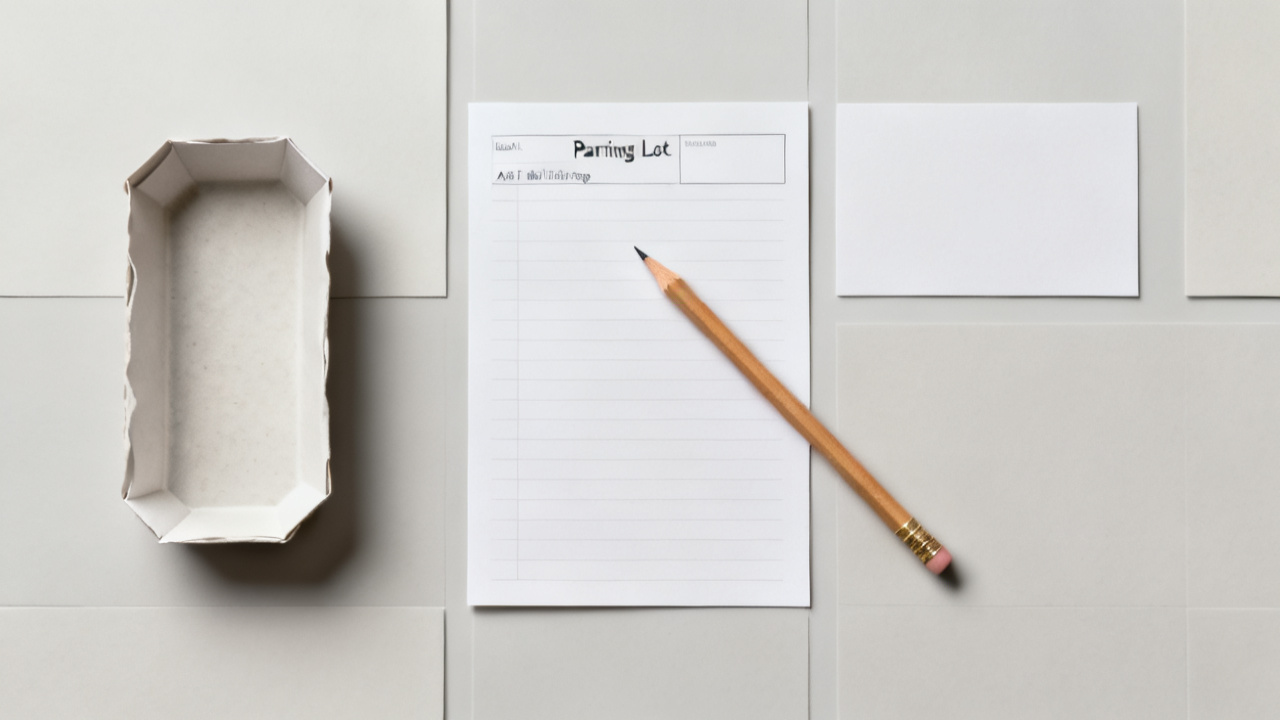
A paper parking lot is a single 3×5 index card kept directly to the left of your keyboard, only used during scheduled deep work blocks. The rule is simple: the second an unplanned interruption, idea, or request pops up that you don’t need to address immediately, you write 3 to 5 words maximum on the card to jog your memory later, then set your pen down and return directly to the task you were working on. No extra details, no prioritization, no searching for the right folder in your task manager, no drafting a follow-up message. The physicality of the card means you don’t have to navigate away from your current screen, so you avoid the risk of falling into a digital rabbit hole before you get back to work. For example, if you get a Slack ping from an intern asking for access to a design tool, you simply write “intern design access” on the card and close the Slack notification without replying. If you suddenly remember you need to order more printer paper for the home office, you write “printer paper restock” and keep typing. The goal is to keep the time you spend away from your core task under 5 seconds per interruption, so you don’t lose the flow state you’ve built.
Lots that become a second todo list
The biggest mistake people make with paper parking lots is treating the card like a secondary to-do list, rather than a temporary capture tool. If you start adding due dates, context, or priority labels to items as you write them, you turn the 5-second capture step into a 2-minute planning task that breaks your flow just as badly as addressing the interruption immediately. Over time, if you don’t clear the card after every block, items pile up across multiple days, creating a cluttered list that feels overwhelming to sort through. Many people also make the mistake of using the same card for all work tasks, mixing parking lot items with meeting notes and grocery lists, so the card loses its specific purpose as an interruption capture tool. Once the card becomes a generic to-do list, you’ll start ignoring it entirely, falling back to your old habit of opening new tabs or dropping your core task to handle small requests as they come in.
After-block triage in four minutes
Right after your scheduled deep work block ends, before you check your full inbox, join a meeting, or move to your next task, you spend exactly 4 minutes triaging every item on the parking lot card. Example timing: 4 minutes total, no extensions, to avoid turning triage into an unplanned work session. The triage flow uses four fixed categories to eliminate decision fatigue, mapped out in the table below:
| Triage Category | Required Action | Example Interruption Item |
|---|---|---|
| Do Now (<2 minute task) | Complete the task immediately before moving to any other scheduled work | Reschedule dentist appointment, reply to intern access request |
| Add to Master To-Do List | Log the item in your primary task manager with appropriate priority, due date, and any necessary context | Draft Q3 team budget outline, order custom client swag for next month’s launch |
| Delegate | Send a 1-sentence request to the appropriate team member with clear expectations for follow-up | Pull last month’s social media engagement numbers, review new freelance contractor onboarding materials |
| Discard | Throw the item out with no further follow-up, no need to log it anywhere | Random side project social media idea, reminder to check a sports game score after work |
After you triage every item on the card, throw the card away entirely. Do not save it for later, do not carry un-triaged items over to a new card. This ensures you start every deep work block with a completely blank card, no leftover clutter from previous sessions. Find Core Insight tested this triage flow with a group of freelance knowledge workers to refine the category labels and cut down on post-block decision fatigue, so you don’t have to spend time customizing the system before you use it.
Live customer calls this lot cannot park
The paper parking lot is designed only for non-urgent, non-time-sensitive interruptions that pop up during deep work blocks, and there are clear boundaries for what you should never park on the card. First, any live customer or client call that requires immediate escalation cannot be parked: if a client calls with a critical issue that is impacting their business operations, you follow your team’s standard escalation policy immediately instead of writing the request down. Any emergency that impacts your personal safety or the safety of your colleagues also takes priority over deep work, and should not be parked. Finally, any time-sensitive request from a manager or team lead with a 60-minute or shorter deadline should be handled immediately, rather than added to the parking lot. For example, if your team lead pings you asking for a sales metric that is needed for a client call starting in 10 minutes, you pull that number and send it over right away, instead of adding it to the parking lot for later triage. Setting these clear boundaries ensures you don’t miss critical requests while protecting your deep work time from unimportant distractions.
Keep a stack of blank 3×5 cards next to your keyboard before you start your next scheduled deep work block, and test the capture and triage flow for one full workday to measure how many unplanned flow breaks you avoid without dropping any low-priority follow-up tasks.