
Pick a Monthly Theme Instead of Forty Goals. Long goal lists create unfinished identities. A monthly theme gives direction without fake precision.
Pick a theme you can judge on Friday
Long goal lists create unfinished identities. A monthly theme gives direction without fake precision. Choose one theme that fits on a sticky note and can guide weekly outcomes—not a slogan you cannot evaluate.
Strong themes are judgeable: Ship onboarding documentation, Clean decision logs for Project Atlas, Protect three morning focus blocks weekly. Weak themes: be more strategic, level up communication—no Friday test exists.
Post the theme where you see it at 9am: monitor edge, notebook cover, phone lock screen note. Visibility beats memory.
Themes are personal or team-level, not company OKR replacements. One theme per person is enough; forty parallel themes recreate the list problem.
Write the theme as a question if that helps judgment: Did documentation ship this week? Questions make Friday evaluation faster than abstract nouns.
Avoid themes that depend on other people’s unpublished decisions unless you name that dependency in the sticky note.
Filter weekly outcomes through the lens
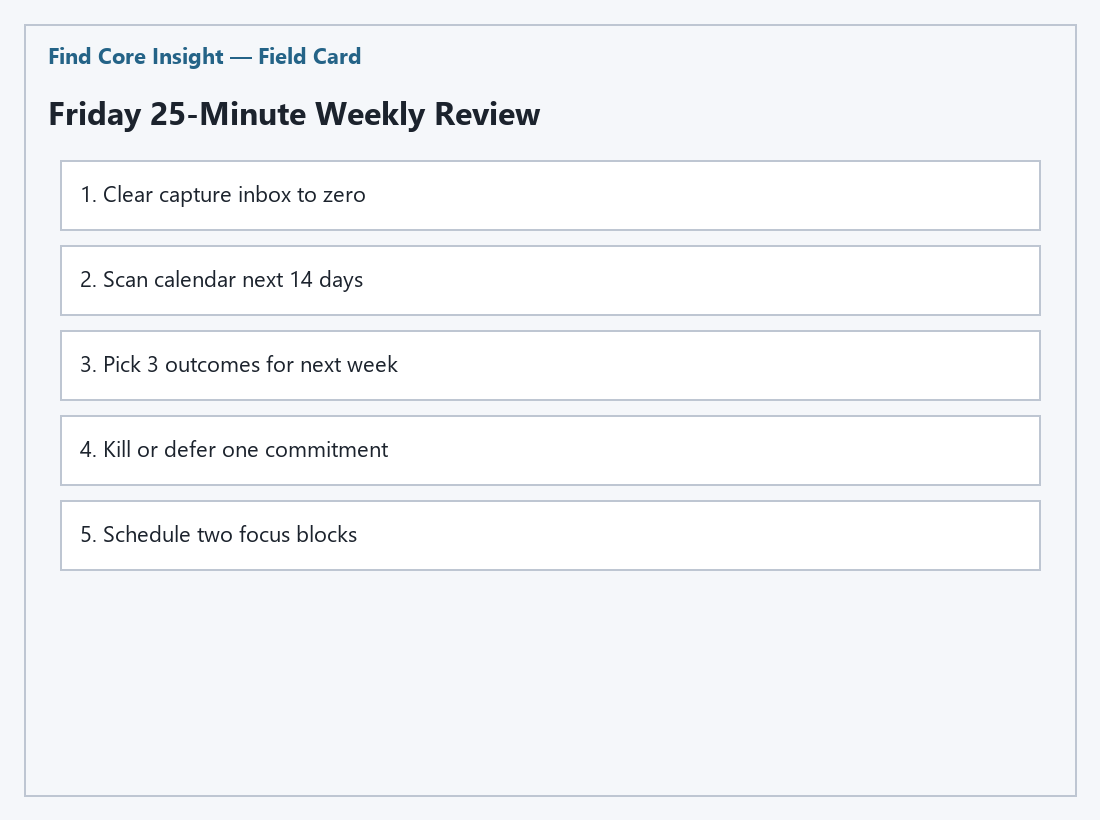
Each Friday during your review, ask whether next week’s three outcomes serve the theme. If not, rename the theme or rewrite the outcomes—do not pretend both are true.
Example: theme Ship onboarding documentation. Valid outcomes: draft FAQ section, record walkthrough video, publish internal link in wiki. Invalid outcomes: reorganize entire wiki taxonomy unless that directly unblocks shipping.
Saying no gets easier with a theme handy: “Not this month—documentation theme until the 30th.” Declines tied to a visible theme feel less personal than arbitrary busyness.
Calendar consequences make themes real. Block hours labeled with the theme name. If you cannot block time, the theme is cosplay until you admit lower priority.
Keep a not this month list visible—requests you declined because of the theme. Review it at month end to see whether the filter actually changed behavior or only sounded good.
Align one standing meeting outcome with the theme when possible so group time reinforces personal focus instead of fighting it.
Mid-month sharpen or replace once
Halfway through the month, spend ten minutes: continue, sharpen, or replace the theme. Replacement is allowed once—constant replacement is avoidance wearing progress clothing.
Sharpening example: Ship onboarding documentation becomes Ship contractor onboarding FAQ and checklist only when scope creep appears. Narrowing is success, not failure.
If reality shifted—a launch moved, a child was sick, a reorg landed—replace the theme with something honest for the remaining weeks. Carry one lesson forward; do not carry guilt.
Teams can share themes in standup briefly: “My theme this month is decision logs for Atlas.” Alignment without forty tracked KPIs.
Mid-month review takes ten minutes on the calendar—same day each month, e.g., the 15th. Unscheduled mid-month reviews never happen.
If you replace the theme, write one sentence why on the sticky note back: Replaced 7/15 — launch moved; new theme: stabilize staging.
Close the month in five lines
On the last workday of the month, write five lines:
- Moved — what actually shipped toward the theme.
- Stuck — blockers that remain.
- Carry — what enters next month.
- Drop — what you will not pretend to finish.
- Next theme — one sticky-note candidate.
Five lines beat a retrospective novel you will not reread. Store them at the bottom of the month’s weekly notes for pattern spotting across quarters.
If moved is empty, inspect whether the theme was too vague or never received calendar hours—adjust next month’s choice using that diagnosis, not generic ambition.
Fewer goals, clearer Fridays. One theme creates a lens; forty goals create noise you learn to ignore.
Compare monthly five-line closes across quarters. Patterns emerge—always stuck on documentation, always drop social goals—without needing a complex tracker.
Photograph the sticky note before you replace it. Visual history beats deleting themes without record.
Avoid stacking themes with unrelated OKRs unless you map them explicitly. Two lenses without translation recreate the forty-goal problem in miniature.
When the month ends strong, carry at most one stuck item into the next theme—not the whole backlog. Themes organize attention; they do not replace project lists.
From theme to weekly calendar
Themes fail when they live only on sticky notes. Each Monday, block at least two hours labeled with the theme name. Without blocks, the theme becomes wallpaper.
Translate the theme into a not-to-do list for the month: conferences you skip, side quests you defer, optional committees you leave. Subtraction makes themes real.
At weekly review, score each outcome yes/no against the theme. Three nos in a row means the theme is wrong or the outcomes are fantasy—fix one of them immediately.
Example: theme Protect mornings with outcomes draft brief Tue 9–11, decline optional Thu sync, move 1:1s to afternoon. Each outcome is verifiable Friday.
Share the theme with a accountability partner in one sentence each Monday. External repetition catches silent drift by Wednesday.
If your org uses quarterly OKRs, pick a theme that supports one OKR only—not all of them. Alignment without overload is the point.
Themes are filters, not quotas
Monthly themes help prioritize everyday work—they are not financial planning, therapy homework, or guaranteed performance outcomes. Adapt or drop the method if your role uses formal goal systems you must follow.