The helpful reply is half written, and the thing you will drop this week is not mentioned once. You’re drafting a confirmation for a last-minute project request, a volunteer shift, or a coffee chat that doesn’t align with your existing priorities, and you’re framing the entire message around how excited you are to show up. What you’re not accounting for is the tradeoff you’ll have to make: Illustrative example: 6 hours of report writing, your kid’s soccer practice carpool, or a long-scheduled doctor’s appointment you will have to reschedule to make the new commitment work. Most people only name the “yes” in their replies, leaving the hidden cost of the associated “no” unstated for both themselves and the recipient.
Find Core Insight editors

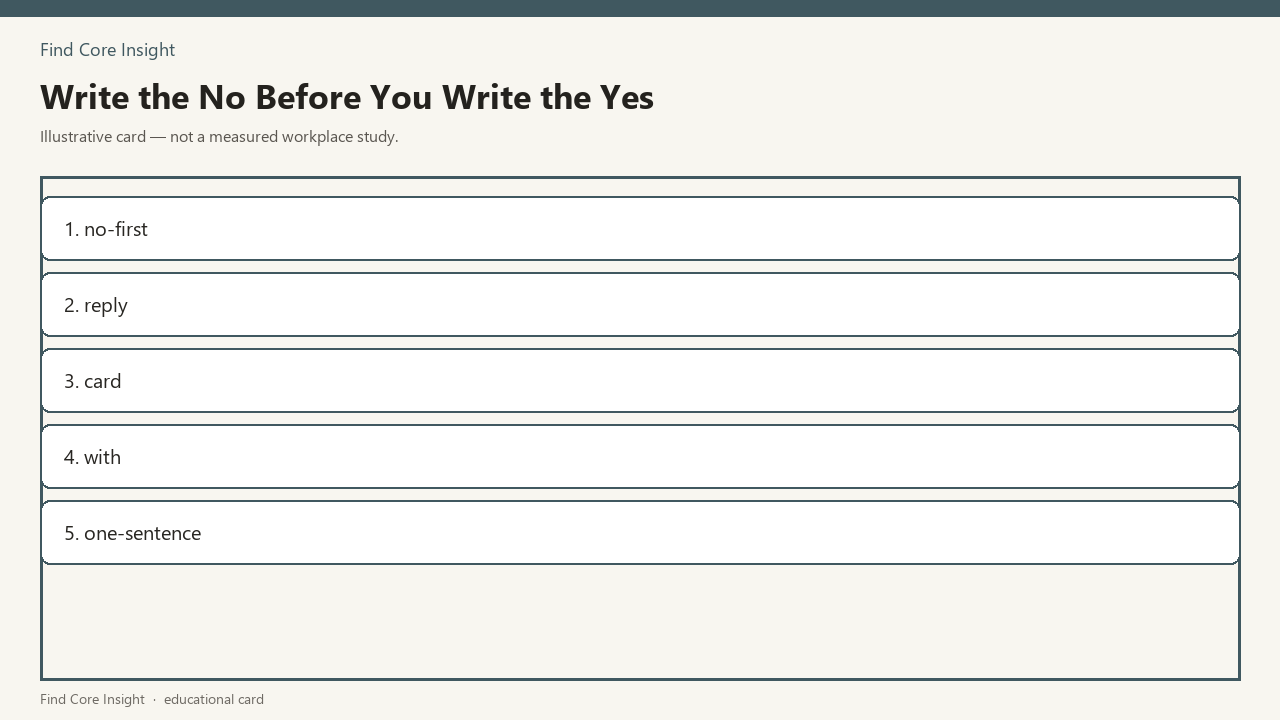
Yes drafts that skip the cost of the no
Defaulting to writing the yes first creates blind spots for everyone involved in the request. When a manager asks if you can take on the client presentation next week, your first draft may be “Absolutely, I can get that to you by Thursday” without mentioning that you’ll have to push the team onboarding documentation you were assigned to complete that same week. The problem here is twofold: first, you’re setting an unrealistic expectation that you can absorb extra work without tradeoffs, which leads to more unplanned requests down the line, and second, you’re not giving the requester full context to decide if the new request is actually higher priority than the work you’re already doing. Many people assume naming the tradeoff will make them seem uncooperative, but it actually gives the other party decision-making power they wouldn’t otherwise have. For example, if your manager knows taking the presentation means delaying onboarding docs, they might assign the presentation to someone else who has more bandwidth that week, rather than having both projects slip.
A no-first sentence you can send or keep
The no-first sentence is a line that names the thing you are saying no to (the tradeoff) before you state the yes to the new request, if you choose to say yes. You can even keep this sentence for your own personal notes if you don’t want to share it with the requester, but writing it first ensures you don’t ignore the hidden cost of your yes. Below is a ready-to-use no-first reply card with pre-written one-sentence templates for common low-stakes requests:
No-First Reply Card: One-Sentence Templates
| Scenario | No-first sentence for internal use only | No-first sentence to share with the requester |
|---|---|---|
| Extra work request from your direct manager | I am saying no to 4 hours of scheduled Q3 onboarding work this week to complete this new request. | To complete this request by your requested deadline, I will need to push the Q3 onboarding draft to next Tuesday; let me know if you would prefer to reassign this new task instead. |
| Volunteer event request from a local community group | I am saying no to my planned weekend hike and grocery run to volunteer at this event. | To make it to the 4-hour volunteer shift on Saturday, I will need to leave 30 minutes early to pick up groceries for the week, which works for me if that timeline fits your schedule. |
| Informational coffee chat request from a professional contact | I am saying no to my weekly deep work block on Wednesday afternoon to take this chat. | I can make 30 minutes for this chat next Wednesday between 1pm and 1:30pm, as that is the only slot I can move around my existing deadline commitments this week. |
| Last-minute shift cover request from a coworker | I am saying no to my planned dinner with my sibling after work to cover this shift. | I can cover the closing shift for you today, but I will need to leave 15 minutes early to make it to a pre-scheduled family dinner, so I will need someone to handle the last lockup check. |
| Family favor request from a relative | I am saying no to my scheduled work presentation prep on Thursday evening to help with this move. | I can help you pack for your move on Thursday evening, but I will need to step away for 30 minutes halfway through to run through a work presentation I’m giving Friday morning. |
Soft noes that still create a new meeting
A common misconception is that soft noes, which kick a request down the line instead of declining it outright, do not require a no-first framing. In reality, soft noes that create a new meeting, follow-up check-in, or future commitment still require you to say no to something, even if it’s just 30 minutes of your calendar next week to discuss the request further. For example, if someone asks you to lead a new committee and you reply “I can’t lead it right now, but let’s chat next month about possibilities,” you’re still saying no to whatever you had scheduled for that 30 minute chat slot next month, and you’re also carrying the mental load of remembering the request until that meeting happens. You can apply the no-first framework here too, by naming the cost of that follow-up meeting before you agree to it, either to yourself or to the requester. For example, you might write first: “I am saying no to 30 minutes of my planned project work next Wednesday to have this chat, and I will need to block that time off now to avoid missing my deadline” before you send the soft no with the meeting invite.
Three replies rewritten with the cost named
To see how the no-first framework works in practice, here are three common reply examples rewritten to include the hidden cost of the yes:
- Original reply to a manager asking for a new sales report by EOD Friday: “Sure, I can have that on your desk by EOD Friday.” Rewritten with no-first framing: “To complete this sales report by EOD Friday, I will need to push the Q3 hiring plan draft to next Tuesday, and I’ve already blocked time for that revised deadline on my calendar. Let me know if you’d prefer I prioritize the hiring plan instead and assign the sales report to someone else.”
- Original reply to a friend asking for help moving next Saturday: “Yeah I can be there at 9am to help!” Rewritten with no-first framing: “To help you move at 9am Saturday, I’ll need to reschedule my regular morning workout and skip the neighborhood clean-up I signed up for, so I’ll have to leave by 2pm to make up that time. That works for me if that timeline works for you.”
- Original reply to a professional contact asking for 30 minutes of your time to pick your brain about your role: “Absolutely, let’s find a time next week.” Rewritten with no-first framing: “To make 30 minutes for this chat next week, I’ll need to move my weekly team check-in prep to after hours one day, so I can only meet between 1pm and 2pm on Wednesday or Thursday. If those times don’t work, I can send you a 2 page written breakdown of the most relevant tips instead, which will take less time for both of us.”
Union or legal notices this reply card cannot handle
This no-first reply card is designed for casual, low-stakes requests where you have full discretion over your time and priorities. It is not intended for formal requests that fall under union contract requirements, legal obligations, or mandatory workplace policies. For example, if your employer requires you to attend a mandatory safety training that falls during your scheduled personal time, you cannot use these templates to decline the request without first consulting your union representative or HR team, as there may be formal processes you need to follow to request an accommodation or exemption. This framework also does not apply to requests that involve emergency situations, such as a last-minute request to cover a shift for a coworker who is experiencing a family emergency, where tradeoffs may be unavoidable and require a different decision-making process. Find Core Insight recommends consulting a qualified union representative or legal professional for any request that falls under formal employment policies or legal requirements.
Next time you draft a reply to a new request, type your no-first sentence first, even if you delete it before sending. Taking 10 seconds to name the tradeoff you’re making will help you avoid overcommitting, and give you full clarity on what you’re choosing to prioritize that week.