
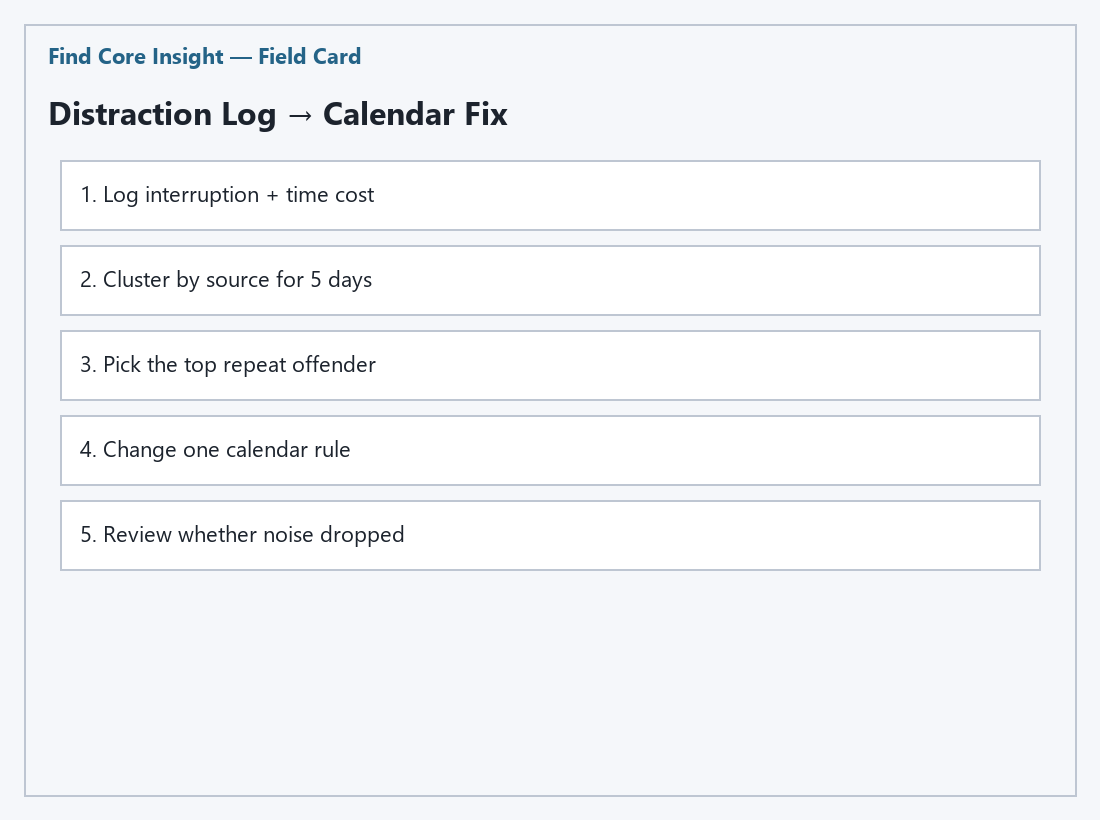
Keep a Distraction Log That Changes Next Week’s Calendar. A distraction log is useless as guilt. Use five days of data to change one rule.
Five days of timestamps, not guilt
A distraction log fails when it becomes a shame diary. For five workdays, record four fields each time you lose focus for more than three minutes:
- Time — approximate clock time.
- Source — Slack, email, self-tab-hop, doorway chat, phone, other.
- Minutes lost — honest estimate, round up slightly.
- Preventable? — yes if a calendar or environment change could reduce it; no if it was a genuine urgent incident.
Keep the log on paper or one note—speed beats perfection. Do not analyze until day five. Daily analysis invites premature rule changes that miss patterns.
Example entries: 2:15pm, Slack, 8 min, yes; 10:40am, news tab, 12 min, yes; 4:50pm, colleague doorway, 6 min, yes; 11:05am, outage page, 25 min, no.
Log only workday hours unless personal devices bleed into work blocks—then include phone checks during focus time. Honesty beats a pretty log.
Do not share raw logs with managers unless you choose to; the tool is for your calendar design first.
Cluster the top offender
On Friday, sort entries by source and by time of day. The top offender is the cluster with the most preventable minutes, not the most entries. One long self-tab-hop session can outweigh ten tiny pings.
Common clusters: post-lunch Slack, late-afternoon doorway chats, morning news checks before first block, meeting pileups with no buffer. Name yours specifically—post-lunch #design channel beats generic Slack.
If self-tab-hopping dominates, environment change comes first: full-screen focus mode, site blockers during named blocks, phone in another room. Slogans lose to design.
If chat culture dominates, share anonymized counts with the team: “Preventable chat interruptions averaged forty-two minutes daily this week.” System fixes beat individual willpower lectures.
Draw a simple bar sketch on paper—minutes by hour. Visual clustering beats sorting rows in your head when you are tired on Friday.
Separate doorway from scheduled meeting overrun. Overruns need buffer blocks; doorways need office hours or headphones cues.
One calendar rule change only
Pick exactly one change for next week based on the cluster:
- Move deep work away from the worst timestamp (e.g., block 1–3pm if post-lunch chat spikes).
- Add a twelve-minute walking reset before the vulnerable hour.
- Set two batch chat windows and mute non-emergency channels outside them.
- Publish office hours for drop-in questions instead of ambient availability.
One rule keeps causality visible. Five rules at once means you never know what worked.
Write the rule in the calendar event description so future-you remembers why 1pm is now a focus block, not a mystery preference.
Example rule change: Moved deep work to 9–11; Slack mute until 11 except #incidents. One sentence in the calendar beats a sticky note lost under the keyboard.
Tell one colleague the rule so social interruptions drop. Silent rule changes still get doorway chats.
Check whether next week’s count dropped
Log three more days the following week with the same four fields. Compare preventable minutes to baseline. If the count dropped by at least twenty percent, keep the rule another two weeks before tweaking.
If the count did not drop, the rule missed the real trigger. Re-cluster and choose a different single change—still one change, not five.
Non-preventible incidents should stay flat. If urgent minutes spike while preventable falls, you may have traded one leak for another—verify that emergencies are truly urgent.
The log’s job is to change next week’s calendar, not to rank your virtue. Retire the log after a successful rule sticks; run another five-day sample quarterly or after a role change.
Target: twenty percent drop in preventable minutes week over week. If you beat forty percent, keep the rule unchanged for a month before optimizing further.
When a rule works, document it in your personal FAQ note: Post-lunch focus 1–3; Slack batch at 3:30. Future role changes start from evidence, not memory.
If the top offender is news or social tabs, block those domains during focus blocks only—not all day—so the rule stays proportional and sustainable.
Repeat the five-day log after major org changes: new chat tool, office return, team merge. Old rules often stop matching new trigger patterns.
Team-visible patterns
When distractions are structural—alert policies, public channels, meeting pileups after lunch—personal logs become evidence for team design. Share totals, not names.
Example team message: “I logged preventable interruptions this week; post-lunch chat was forty percent. Can we try a quiet hour 1–2 in #design?”
If the team adopts a quiet hour, log again to verify the rule actually moved minutes. Policies without measurement often become performative.
Personal logs can retire once a team rule sticks. Maintain a quarterly five-day sample to catch regression when new channels appear.
When logging feels tedious, shorten to three days—but still change one rule. Three days with a calendar change beats five days without one.
Combine distraction logging with batch windows: if Slack dominates, windows are the fix; if self-tab-hopping dominates, blockers are the fix. Match intervention to cluster type.
Logs serve design, not self-blame
Distraction logging here is a lightweight calendar tool for knowledge workers—not surveillance, not a clinical attention assessment. Skip detailed logging if your workplace policy restricts personal activity records.