
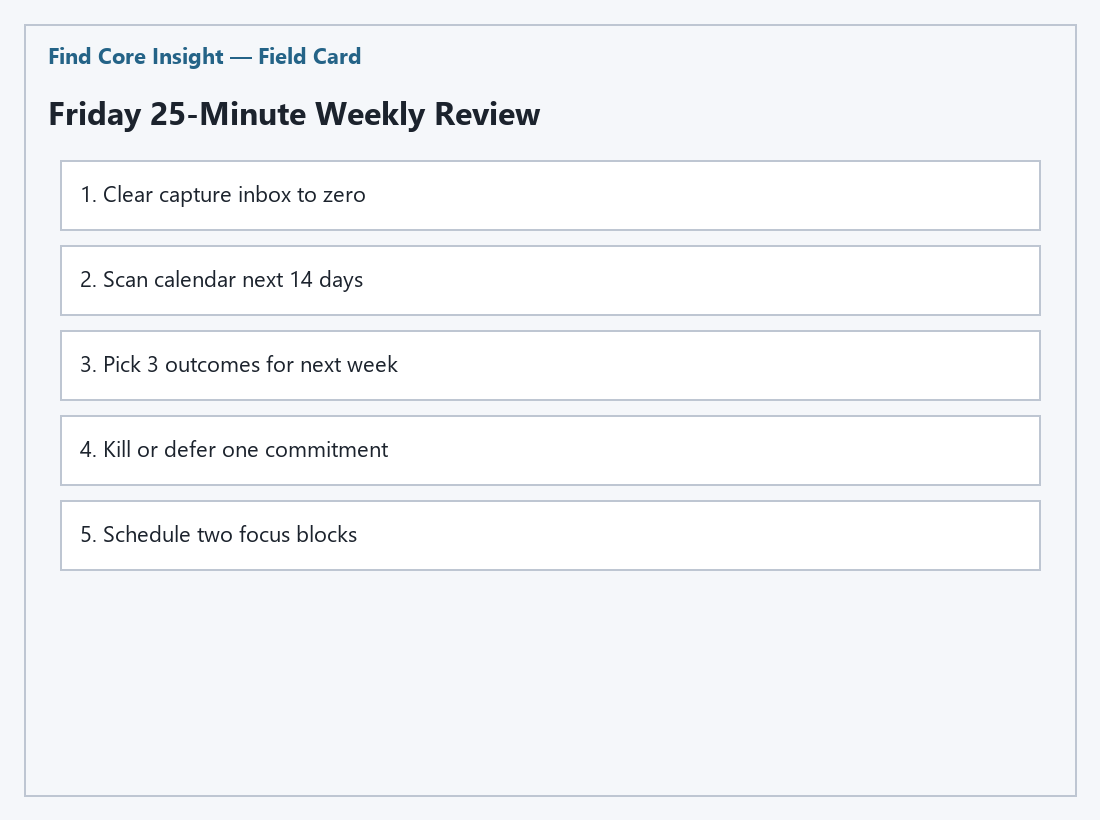
A Friday 25-Minute Weekly Review Script. Weekly reviews fail as journaling marathons. Twenty-five minutes works with a fixed script.
The five-segment timer script
Weekly reviews collapse when they become open-ended journaling. A fixed script with a kitchen timer turns Friday into a closing ceremony instead of another task you postpone until Sunday night. Block twenty-five minutes on the calendar, phone in another room, same chair if you can. The script below is written in minutes so you do not invent a new review every week.
- 0–5 — Inbox sweep. Process capture to empty-enough: delete trash, convert keepers into next actions with verbs and owners, park unclear items under a dated clarify note. Empty-enough means nothing vague like “deal with budget” remains.
- 5–12 — Calendar scan. Look back seven days for slipped commitments and forward fourteen days for collisions. Move one hard task onto a real block before you leave. If the task has no block, it is a wish.
- 12–18 — Three outcomes. Name three outcomes for next week that could actually finish. Outcomes are done states, not themes. “Ship onboarding FAQ draft” beats “work on docs.”
- 18–22 — Subtraction. Kill or defer one commitment. Reviews that only add produce fantasy calendars. Write what drops and who needs to know.
- 22–25 — Two focus blocks. Place two protected blocks on next week’s calendar with deliverable titles, not “busy.” Leave with those blocks saved, not mentally scheduled.
Artifacts matter more than mood. You succeed when you leave with an empty-enough inbox, three named outcomes, and two calendar blocks. If those three are missing, you wrote feelings—you did not review.
Example Friday note header: 2026-07-11 review — loops closed: 6; outcomes: FAQ draft, staging migration step 2, hire panel questions; blocks: Tue 9–11 draft, Thu 9–10.5 interview prep; dropped: optional industry webinar. That header takes ninety seconds and makes Monday legible.
Run the script with the same tool each week—paper, one doc, or one note tagged weekly-review. Tool-hopping between Fridays erases patterns you could learn from in month two.
When the inbox fights back
Some Fridays the inbox is a archaeological site. Do not extend the timer on day one. Run the five segments anyway and stop at twenty-five minutes even if the inbox is not perfect. Perfectionism is how reviews become marathons that never repeat.
If you hit the timer with more than ten unclear lines, create one note titled clarify Monday 9:00 and list the lines there. Monday’s job is clarity; Friday’s job is closure. Mixing them trains you to dread Friday.
Calendar scan should surface at least one collision: two hard tasks in one afternoon, a review without prep time, or a meeting stack with no lunch. Fix one collision now. Fixing all of them is a separate weekly planning session, not this script.
When outcomes balloon beyond three, you are writing a quarterly plan in disguise. Force-rank. The fourth outcome can live on a someday list with a review date, not on next week’s critical path.
If a VP drops a Friday 4pm request into your inbox during the review, finish the twenty-five-minute container first unless the building is literally on fire. Interrupting the script teaches you that reviews are optional—which they cannot be if Mondays matter.
Photograph or screenshot your calendar after the scan segment. Visual proof of moved blocks beats trusting memory when Monday chaos arrives.
Carry unfinished outcomes honestly
Missed outcomes from last week should reappear explicitly, not vanish into guilt. During the twelve-to-eighteen minute segment, copy unfinished outcomes forward or rename them with a smaller scope. “Finish entire migration” becomes “Migrate staging database and document rollback steps.” Honest carry-forward beats silent recycling.
If you miss Friday entirely, run a twelve-minute Sunday version: inbox sweep shortened to three minutes, one outcome for Monday, one focus block. Never run a guilt marathon that poisons the weekend and still produces no blocks.
Keep weekly notes in one place—a single doc, one notebook section, or one tagged note. After four Fridays, read all four notes in one sitting. Delete script steps you never used. Customization should subtract steps, not add them.
Share one outcome with a collaborator if your work is intertwined. Shared visibility prevents Monday surprises when your “done” assumed their input.
Carry-forward language should appear in writing, not vibes: carried from 7/4 — still open — narrowed scope to section 2 only. Vague carry-forward is how the same outcome haunts six Fridays without moving.
When you defer, name the new date and the person who must agree. Deferred vendor demo until 7/20 pending budget sign-off from Finance. Deferred without dates is deleted with extra steps.
Signals that the script is working
Track open loops closed, not happiness scores. Mood journaling rarely changes Monday behavior; closed loops do. A simple tally at the bottom of your note—loops closed: 7—is enough.
Another signal: Monday morning starts with the first focus block already named in the calendar from Friday’s last segment. If you still choose tasks from scratch each Monday, the review is not landing.
After a month, count how many Fridays you ran the full script versus partial or skipped. Above three out of four is a habit. Below two, shrink further—maybe only calendar scan plus two outcomes until the container feels safe.
Teams benefit when individuals run personal reviews even if the org has no ritual. You arrive Monday with fewer hidden dependencies and clearer declines.
Compare time spent in the review to time spent re-deciding priorities each Monday. Most people spend more than twenty-five minutes on Monday reorientation when Friday closure is skipped—that is the business case for keeping the timer sacred.
If subtraction feels socially hard, subtract internally first: remove a self-imposed goal before removing a commitment involving others. Practice the muscle on low-stakes drops.
A note on scope
Find Core Insight publishes practical focus and review routines for everyday knowledge work. This script is educational guidance, not a promise of outcomes in every role or workplace culture.