
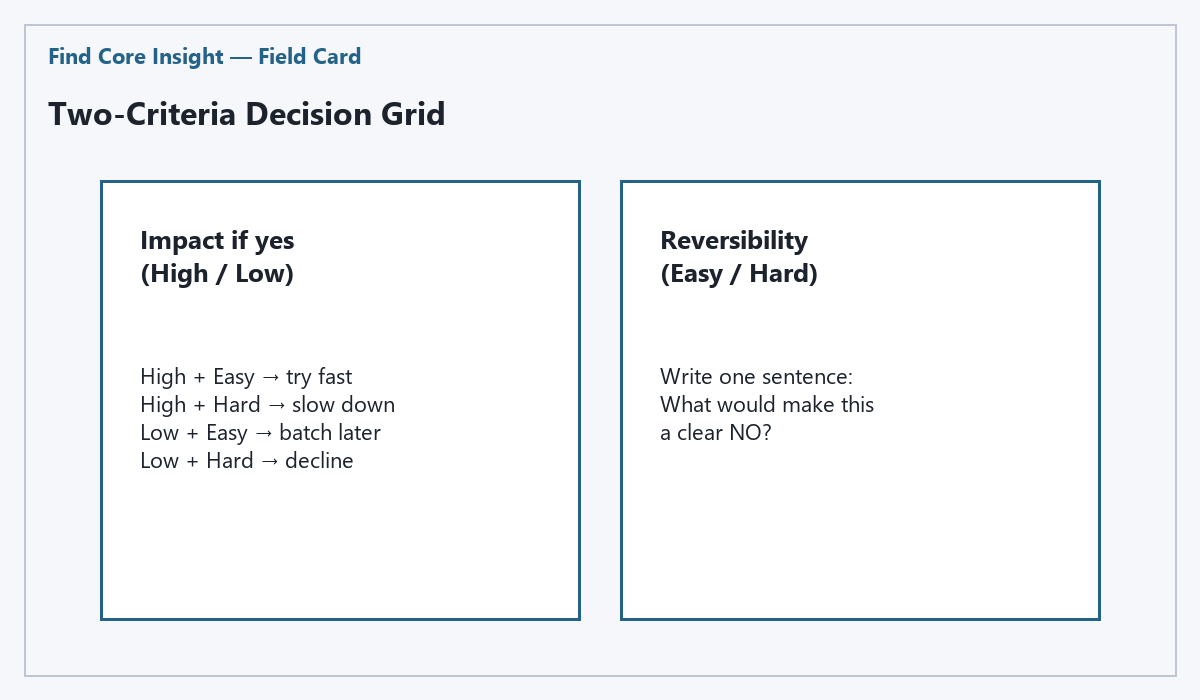
A Two-Criteria Decision Grid for Everyday Work Choices. Most work choices need impact and reversibility—not a twelve-factor matrix.
Why two axes beat long pros-and-cons lists
Most workplace choices stall because the team treats every option as equally serious. A pros-and-cons list feels democratic, but it hides the two questions that actually matter: how much does this choice move the outcome, and how expensive is it to undo. When those two dimensions stay invisible, people argue about taste instead of risk.
Impact is not drama. Impact is whether the decision changes customer experience, team capacity, or public commitments in a way you will notice in thirty days. Reversibility is whether you can walk back the choice within a week without burning trust or money. A new meeting template is low impact and easy to reverse. A public pricing page change is high impact and hard to reverse. Same meeting room, different physics.
Two criteria keep the conversation honest without turning every Tuesday into a workshop. You are not eliminating judgment—you are placing judgment on the right shelf before anyone opens a spreadsheet.
Consider a team choosing whether to add a fourth weekly standup. Pros-and-cons lists treat “more alignment” and “more meeting fatigue” as equal weights. The grid asks a sharper pair of questions: will an extra standup materially change delivery in thirty days, and can we delete it next week if it does not? Often the dot lands low-impact and easy-to-reverse—which means try it for two weeks with a review date instead of a forty-minute opinion tour.
Leaders who love data sometimes resist the grid because it feels subjective. It is subjective—and faster than pretending spreadsheet rows are objective when the inputs are guesses. The grid makes guesses visible so you can revisit them on the review date instead of pretending the first meeting was science.
Drawing the impact and reversibility grid
Draw a simple cross on a whiteboard or shared doc. Label the vertical axis impact (low at the bottom, high at the top) and the horizontal axis reversibility (hard to reverse on the left, easy on the right). Place the decision as a dot, not a debate. Silent placement for three minutes prevents the loudest voice from anchoring the room.
Teach the four boxes once:
- High impact, easy to reverse — try small, set a review date, move fast.
- High impact, hard to reverse — slow down, name an approver, run a short pre-mortem.
- Low impact, easy to reverse — delegate or batch with other small choices.
- Low impact, hard to reverse — usually decline; pain without payoff.
Photograph the grid and attach it to the project note. The artifact matters more than the performance of collaboration. Next week, when someone asks why you moved quickly on one item and slowly on another, you have a shared picture instead of remembered vibes.
Where each quadrant sends you
In the high-impact, easy-to-reverse quadrant, bias toward pilots. Ship a limited version, measure for two weeks, and keep an exit path visible. Teams stall here because they want certainty before a reversible trial—which is backwards. Certainty often arrives after the trial, not before it.
In the high-impact, hard-to-reverse quadrant, require a named decision owner and a written clear-NO sentence: what would make this an obvious no. If the team cannot write that sentence, they do not yet understand the constraints. Schedule a decision block instead of extending discussion across five calendar weeks.
Low-impact choices deserve less airtime than they usually get. Batch them into a fifteen-minute admin block on Fridays. Low impact with hard reversal is the trap quadrant: small-looking commitments that create permanent process (another approval layer, another standing meeting) without moving outcomes. Say no early.
A real vendor-selection meeting in twenty minutes
A six-person product team needed to pick a feedback widget for beta testers. Someone opened a forty-line comparison doc. The manager drew the grid instead. Placement took four minutes: moderate impact (beta experience), easy to reverse (exportable data, no public promise).
That placement changed the agenda. Instead of scoring seventeen features, they agreed on a two-week pilot with one vendor, a review date, and a rollback plan if export failed. Total meeting time: twenty minutes. The alternative path—consensus on a “forever” tool—had already consumed two prior sessions.
Write the clear-NO sentence once per real choice. For the widget, it was: clear NO if we cannot export responses without vendor support on day one. That single line ended option brainstorming that was drifting into brand preferences. The grid did not remove disagreement; it moved disagreement to the right moment.
After the pilot, they re-placed the dot: still moderate impact, still reversible until a public beta page linked the widget. That second placement triggered a pre-mortem before marketing copy went live—same tool, different quadrant moment. The grid is not a one-time stamp; it tracks how risk changes as scope grows.
Teaching the grid in a remote room
Remote teams can use a shared doc with a simple ASCII cross or a whiteboard photo template. Drop a comment pin for the decision dot; ask everyone to place a private pin first, then reveal together. Three minutes of silent placement still works when cameras are on mute.
Facilitator script in chat: Place your dot. No sentences yet. When I say reveal, type high/low impact and easy/hard reverse in one line. Disagreement about placement is useful data—if half the room sees high impact and half sees low, you probably have not defined the scope tightly enough. Shrink the decision until placement converges.
End by assigning a quadrant action, not a consensus feeling. High/easy gets a pilot owner and review date. High/hard gets a decision owner and pre-mortem invite. Low/easy gets delegated with a one-line checkpoint. Low/hard gets a default no unless someone writes why the irreversible cost is worth it.
Keep a gallery of photographed grids in the project folder. New hires learn the team’s risk language faster from pictures than from values posters. The grid becomes vocabulary: “That sounds high-hard—who owns the pre-mortem?”
Carry the grid into chat this week
Pick one decision that is stuck in Slack threads. Draw the grid in the thread or a one-page doc, place the dot silently, and reply with the quadrant name plus your clear-NO sentence. If the choice lands high/hard, schedule a pre-mortem before the next options meeting—not after. Find Core Insight publishes everyday decision frameworks for work; this is practical education, not a guarantee of outcomes in every organization.