
An End-of-Day Shutdown Ritual That Leaves Work at the Desk. Without shutdown, unfinished loops follow you home. A short ritual parks work safely.
The twelve-minute closing sequence
Without shutdown, unfinished loops replay during dinner. A short ritual parks work on paper so your brain can leave the desk. Set a timer for twelve minutes maximum—longer usually means you started tomorrow’s work and called it responsibility.
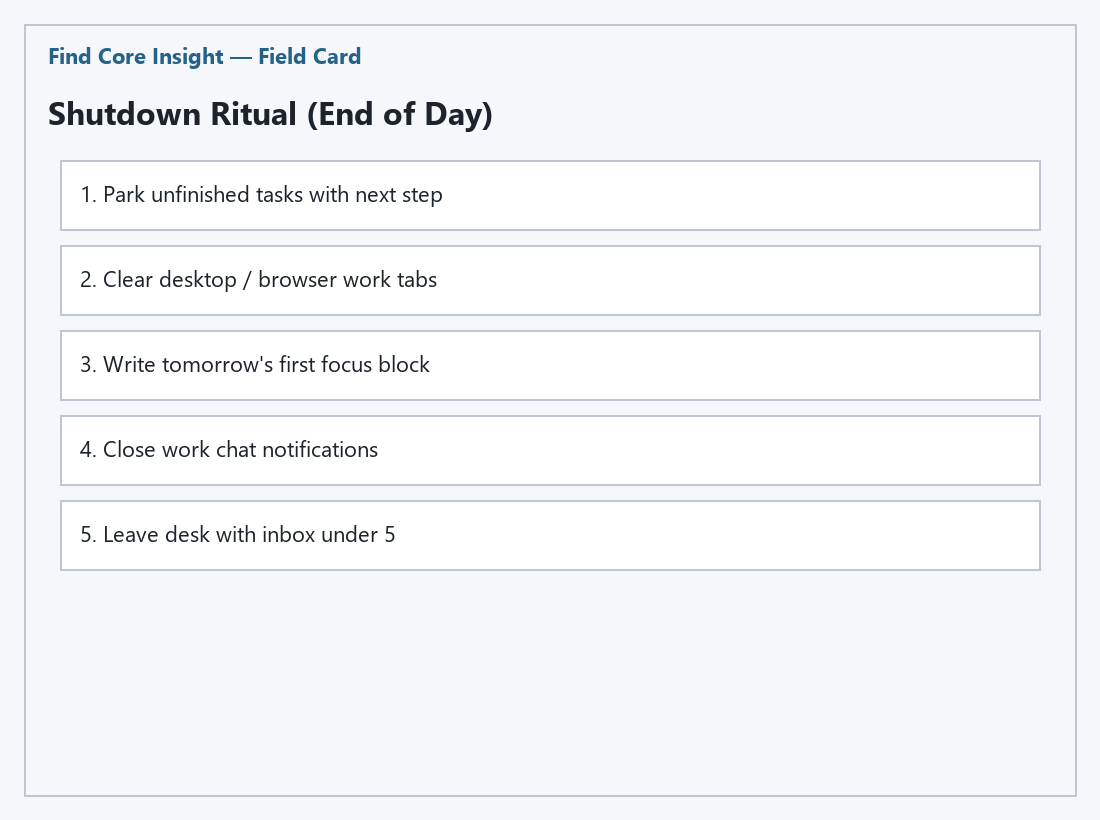
- Park open tasks. Each open loop gets a next physical step written in boring language. “Email Sam the revised timeline by Tuesday 10:00” not “follow up.”
- Clear surface noise. Close tabs you will not reopen tonight; file downloads; reset desktop to a neutral state. Visual clutter pulls attention back.
- Write tomorrow’s first block. Name the deliverable and first action in the calendar or task list. Monday-you should not negotiate with Friday-you.
- Close work chat. Set status if your team uses it. Optional one-line note: Back tomorrow 9:00; urgent items text.
- Inbox under five. Not zero—under five. Process quick replies; park the rest with next steps. Inbox zero at night often becomes inbox heroics.
When the timer ends, stop even if one tab remains. Finish that tab tomorrow inside a named block, not as a stealth evening session.
Example parked note: Tomorrow 9:00 — open contractor FAQ outline; first action: paste last quarter’s onboarding email thread into doc comments. Boring specificity is the product.
Keep shutdown supplies in one place—notebook, charger, inbox shortcut—so the ritual does not become a scavenger hunt that exceeds twelve minutes before you begin.
Park loops with boring next steps
Vague parking notes recreate mental replay. If you write “think about roadmap,” your mind treats the loop as still active. Replace thinking verbs with visible actions: “List three roadmap risks on one page” or “Schedule thirty minutes with Priya to review assumptions.”
Night ideas belong in capture, not full execution. A single inbox line or voice memo is enough. Processing the idea can wait for a focus block or Friday review. Shutdown protects boundaries; capture protects insights.
For collaborative threads, park who owes the next move. “Waiting on legal review” is incomplete. “Send reminder to legal if no reply by Wednesday noon” closes the loop externally.
If parking takes more than four minutes per item, the item is not parked—it is half-done. Shrink scope or defer to a calendar block with a start time.
Batch similar parking lines: five Slack threads become one line Reply to design, finance, and ops threads Tuesday 10:30 batch window. Batching reduces note length without losing clarity.
Avoid parking emotional processing as work tasks. Feel bad about presentation is not a next step. Write three bullet improvements for deck slide 4 is.
Cues that signal done for the night
Rituals need a sensory finish. Close the laptop lid, turn off the desk lamp, or take a five-minute walk around the block. The cue tells housemates and your nervous system that work mode ended.
A one-line done for night message to yourself or a partner reinforces closure without reopening work chat. Keep it off Slack unless your culture expects availability—personal notes work fine.
Track nights you mentally replay work for more than five minutes after shutdown. That count should fall as parking quality improves. If replay stays high, audit your next steps for vagueness before blaming willpower.
Consistency matters more than perfection. Five consecutive weekdays with any shutdown beat one perfect shutdown followed by a week of midnight laptop opens.
Housemates learn the cue faster than you expect. A closed laptop lid at 6:15pm becomes a reliable signal that you are present—not half at the desk mentally.
Measure replay nights weekly: replay nights: 2/5. Trend down over three weeks or rewrite parking notes until they are mechanically clear.
Micro-shutdown on late nights
Late nights happen. Run a two-minute micro-shutdown instead of skipping entirely: write tomorrow’s first action, close chat, close the laptop. Skipped rituals die faster than shortened ones.
Do not use late nights to “catch up” on email unless it is a genuine incident. Chronic catch-up means daytime blocks are mislabeled or meetings ate the wrong hours—fix the calendar, not the evening.
Weekends do not require full shutdown unless you work weekends. If you peek at email Saturday, use capture-only rules: note the idea, do not execute project work. Monday’s focus block exists for execution.
Teams with global hours may shift shutdown earlier relative to local evening. The ritual still applies—park loops before you context-switch to family or rest, whenever that switch happens.
Travel weeks: micro-shutdown only is acceptable. Rebuild full twelve-minute ritual the first normal day back—jet lag is not a reason to abandon cues for two weeks.
Pair shutdown with a written first meeting tomorrow line if mornings start with standing meetings. Knowing the first external obligation reduces 6am mental rehearsal.
Shutdown checklist on paper
Some people run shutdown faster with a laminated card on the desk: park, clear, tomorrow block, close chat, inbox under five. Reading beats remembering when you are tired.
Children and partners learn the ritual when it is consistent—same time band, same cue. Inconsistent shutdown teaches the household that work never ends.
If you work from a shared space, add one step: pack laptop into bag or cover keyboard. Physical separation matters when there is no commute to mark the boundary.
Weekly tally: full shutdowns 4/5. Micro-shutdowns count as half for the tally—honest accounting keeps the habit from becoming all-or-nothing.
Evenings are not overflow buffers
This shutdown checklist is a work-boundary habit for office and remote contexts. It is not sleep therapy or medical guidance—if evenings stay restless despite clear parking notes, look at overall workload and recovery outside this article’s scope.