
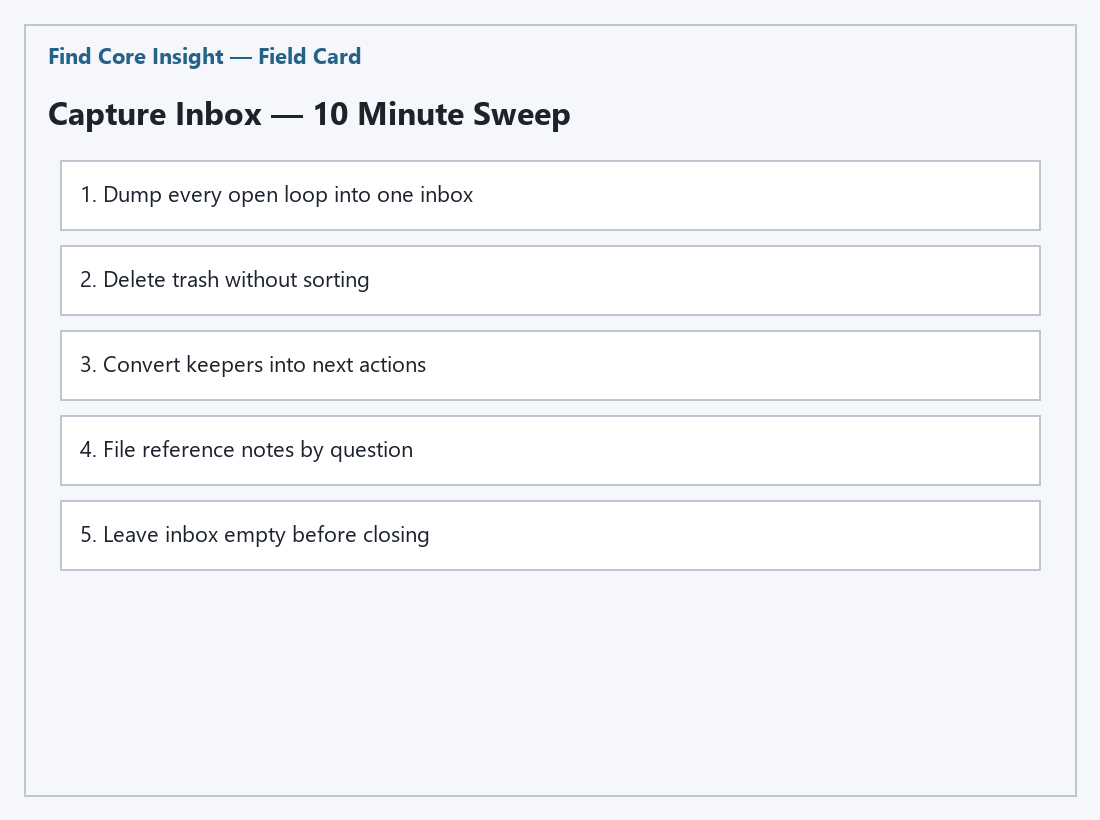
Clear a Capture Inbox in 10 Minutes Without Fancy Apps. A capture inbox fails when it becomes a second to-do list. This 10-minute sweep empties one surface without buying another app.
Tuesday 9:12 — Maya opens three capture surfaces
Maya keeps a phone quick-capture list, a labeled email folder called inbox-capture, and one sticky page in a pocket notebook. At 9:12 she starts a ten-minute timer—not because she lacks discipline, but because the timer defines when the sweep ends. Her rule: touch each surface once, in fixed order (phone, email label, notebook page). She does not open Slack, her task app, or a second notes tool during the sweep.
Before the timer, she writes one line on the sticky: Empty means every line has a next home. That line prevents the common failure where she clears by moving items into a vague Someday list that is really a second inbox. She learned that lesson in February when her Someday note hit ninety lines and felt worse than the original pile.
Maya runs the sweep at mid-morning when energy is medium. Evening sweeps while exhausted produced archive theater—half the lines moved unread into Misc and returned by Wednesday. Consistency at an imperfect time beats a perfect time she never keeps.
Minute one through four: dump without sorting
Maya reads each capture line aloud once—quietly at her desk, out loud when walking. Reading aloud catches duplicates her eyes skim past. She does not tag, prioritize, or rewrite titles during dump. If a line says budget thing, she leaves it ugly until minute five.
On Tuesdays she often finds three repeat captures about the same contractor invoice. That repetition is a signal: the original line never got a physical next action. She circles those repeats in pencil; they will need verb surgery in the next phase. Repeats are data, not shame.
During dump she silences chat and refuses quick checks that are not the inbox surface. The ten minutes are a container. If she breaks the container twice in one session, she stops and reschedules rather than practicing a broken ritual. One restart is allowed; two means the day is wrong for sweeping.
Minute five through eight: the delete, task, or file fork
For each line Maya asks one question: Can I delete this without anyone noticing in a week? Meeting notes already summarized in email—delete. A screenshot of a parking sign for a trip that ended—delete. Everything else gets one of two homes: her task list (if it needs a calendar block) or a dated note (if it is reference or a question).
She rewrites vague lines with a copyable micro-template:
- Task: Verb + object + who/when — Email Sam the revised timeline draft by Thursday 4pm
- Question note: Question title + one fact — Why did the March pilot slip? — vendor cited API rate limits in call 3/12
Next-action quality decides whether the pile returns tomorrow. Deal with budget recreates fog; export last month spend CSV and highlight three anomalies for Sam is a next action. When verbs stay vague, the inbox becomes a museum of intentions. She spends the extra fifteen seconds on verbs because it saves another ten-minute sweep later.
When she cannot decide in fifteen seconds, she creates a clarify-Friday note with the raw line and schedules a five-minute block—not a third inbox.
Minute nine and ten: close the surfaces
Maya archives processed email captures, clears the phone list to zero, and tears off the notebook page after photographing it if it contained reference. Zero visible capture lines is the measurable signal she logs in a weekly tally: empty-inbox nights divided by work nights.
Her first week she hit three of five nights—not great. She shrunk to two surfaces (phone and email only) and reached four of five by week three. Adding tools before hitting eighty percent on one surface is a failure mode she watches for. Tool shopping is often a delay tactic wearing a productivity costume.
After five workdays she reviews the percentage. Below fifty percent, shrink the surface again. Above eighty percent, she may add a second short sweep—not a second app.
Failure modes Maya actually hit
Heroic sorting: spending twenty minutes color-coding during the sweep. Fix: sorting happens outside the ten-minute box, never inside.
Archive theater: moving lines into an untitled note called Misc. Fix: Misc is banned; unclear items get clarify-Friday or delete.
Evening sweeps while exhausted: she archived half unread and recreated the pile by Wednesday. Fix: mid-morning only, timer non-negotiable.
Deferred anxiety lines: items left in inbox because I am not sure. Fix: unsure is a tag on a calendar block, not a reason to keep a capture line alive indefinitely.
What changed after thirty days
Maya stopped losing contractor follow-ups—not because she became more organized in general, but because repeats surfaced every Tuesday and forced a real next action. Her empty-inbox rate went from three-of-five to four-of-five nights. The pocket notebook shrank from a daily page to two pages per week because fewer things lived only in her head.
The sweep did not solve big strategic questions. It made sure those questions lived in searchable notes with verbs attached, not in a capture pile that felt like work but was not. She still has hard weeks; the difference is the pile no longer lies about being under control.
Start tomorrow with one surface, not three
Pick the capture surface that embarrasses you most—the one you check at red lights. Run the ten-minute timer there for five workdays before adding a second surface. Log empty-or-not each night; that fraction matters more than how clean the system looks in a screenshot.
If you miss two nights in a row, shrink scope rather than doubling time. A surviving two-surface habit beats an abandoned perfect stack. This is a field guide, not a mandate—adjust the clock time, keep the fork rules.
Capture tools multiply; capture discipline does not. The sweep wins when the fork rules stay boring.