
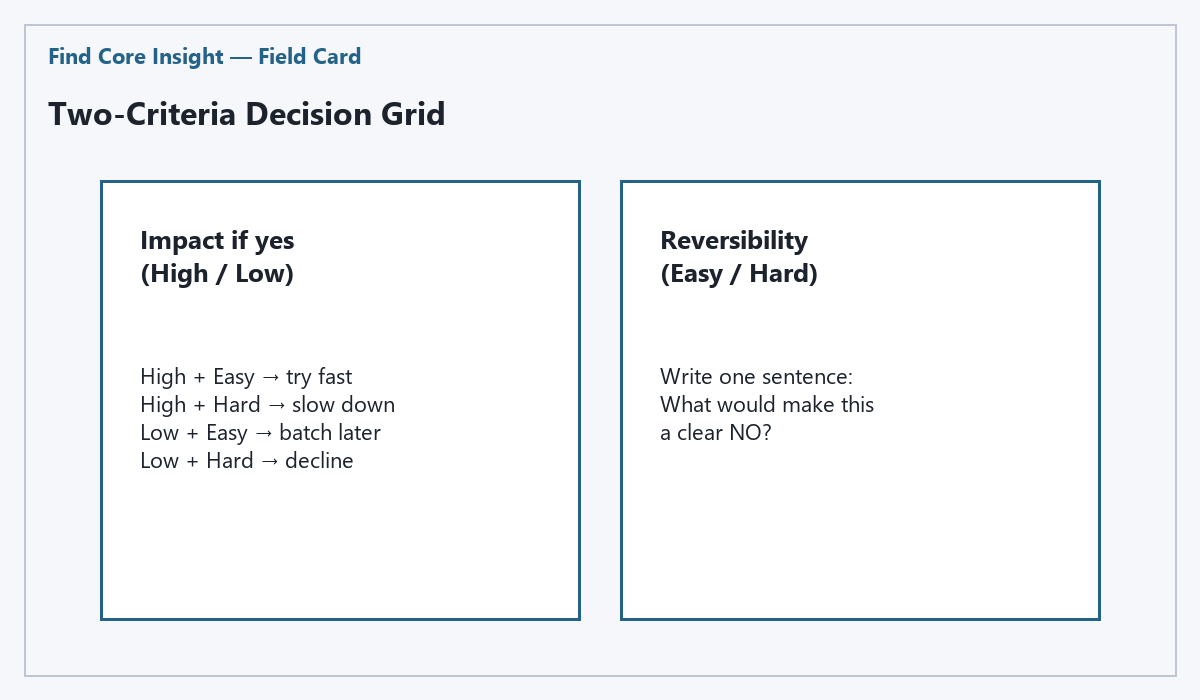
Reversible vs Irreversible Decisions: Choose Your Speed. Treating every choice like forever creates delay theater. Label reversibility, then pick speed.
The one-line classification question
Before debating options, ask: Can we undo this in a week with modest cost? Yes means reversible. No means irreversible in practice—even if someone labels it an experiment. Classification takes thirty seconds and saves thirty-minute arguments misfired at the wrong speed.
Reversible choices deserve defaults: ship small, set a review date, keep an exit path written in the project note. Irreversible choices deserve defaults: name who can say no, list evidence needed, set a decide-by date. Speed without a label is mostly anxiety management dressed as agility.
Exportable tool trials are often reversible. Hiring, public pricing, and trust-breaking announcements are rarely reversible in practice even when slides call them pilots. Write the undo path when you claim reversible—or admit you cannot.
Teams confuse technically reversible with organizationally reversible. You can revert a feature flag in an hour; you cannot revert customer confusion after a confusing release note. Label using the stricter of the two tests when public communication is involved.
Checklist for reversible choices
Use this checklist when the undo path is credible:
- Define the smallest version that tests the hypothesis.
- Set a review date no longer than two weeks out.
- Write the rollback steps where the doers can see them.
- Assign one owner for the experiment—not a committee.
- Agree on one metric or signal that ends the trial early if it fails.
Reversible does not mean careless. It means you stop pretending you need perfect information before motion. Teams stall on reversible choices because a senior person is in the room and everyone mirrors their caution. Label first, then match pace.
Pair the checklist with a visible review date in the calendar—not “sometime next sprint.” Reversible experiments without review dates become permanent fixtures with extra steps. The review is where you promote, kill, or shrink the experiment based on signal, not sentiment.
Checklist for irreversible choices
Use this checklist when undo is expensive:
- Name the single decision owner—two owners is deadlock risk.
- List options considered, even the ones already rejected.
- Run a short pre-mortem or explicit risk row in the decision log.
- Schedule the decision block; do not let discussion sprawl across passive meetings.
- Communicate after decide, not during endless consultation.
Irreversible work still benefits from deadlines. Open-ended “we need more data” on hard-to-undo choices is how quarters disappear. Data thresholds should be written: what evidence ends debate.
Irreversible checklists pair well with decision logs. When the decide-by date arrives, the log entry should already list options considered—even rejected ones—so reopening debate requires new evidence, not new opinions. That pairing reduces circular meetings without killing necessary reconsideration when facts change.
Mislabeled decisions that burned a Tuesday
A team treated a customer-facing pricing FAQ update as reversible because “it is just a doc.” Marketing had already quoted numbers in outbound mail. Rollback required correction emails—trust spend, not a doc revert. Label: irreversible in practice. Should have had a decide-by owner and a pre-mortem on public wording.
Opposite mistake: a internal dashboard color refresh consumed three meetings because a director joined and everyone slowed down. Label: reversible. Should have shipped Tuesday and reviewed Friday.
After-the-fact labeling of last week’s ten decisions is good training. Mismatches teach more than a values poster. Then label the next ten in real time at discussion start. Fast is correct for easy undo. Slow is correct for money, trust, and public commitments.
Build a team habit: first slide or first doc line is the label, not slide ten after forty minutes of options. Facilitators can refuse to open option decks until the label is written. That single gate changes meeting culture faster than post-mortems about meeting culture.
Keep a shared list of labeled decisions for one month. Review it in retro: where did we move too slow? Too fast? The list becomes training data for your team’s risk appetite—not a scoreboard for blame.
Speed defaults once the label is agreed
Reversible defaults: fifteen-minute decision cap, one owner, ship smallest version today, review in ten business days. Irreversible defaults: named approver, decision log entry, pre-mortem or explicit risk row, decide-by date within two weeks unless legal review requires longer—with legal named on the calendar.
Defaults remove renegotiation of process every time. People argue about the choice, not about whether the choice deserves a choice. New hires learn speed norms from labels, not from tribal memory about which director slows which topic.
When labels disagree between functions—legal sees irreversible, product sees reversible—treat that disagreement as the meeting agenda. Resolve label conflict before comparing vendors or copy. Mixed labels without resolution produce mixed speeds and angry Slack threads later.
Train with real decisions from last month, not hypotheticals. People learn labels faster when they recognize Tuesday’s meeting in the example. Hypothetical training feels virtuous and evaporates under schedule pressure.
Post the two checklists where your team already plans work—not in a handbook appendix. Checklists used beat checklists admired. Link them from the project template so every new doc starts with label plus checklist reminder.
When in doubt, label irreversible. The cost of moving slightly slower on a reversible choice is small; the cost of rushing an irreversible choice is large. Conservative labeling errs toward safety without banning speed where undo is cheap.
Label before options next meeting
Open your next decision discussion by writing reversible or irreversible on the doc title line before anyone presents slides. Match meeting length and approvers to that label. Educational framing for everyday work decisions—not legal, financial, or compliance guidance.