
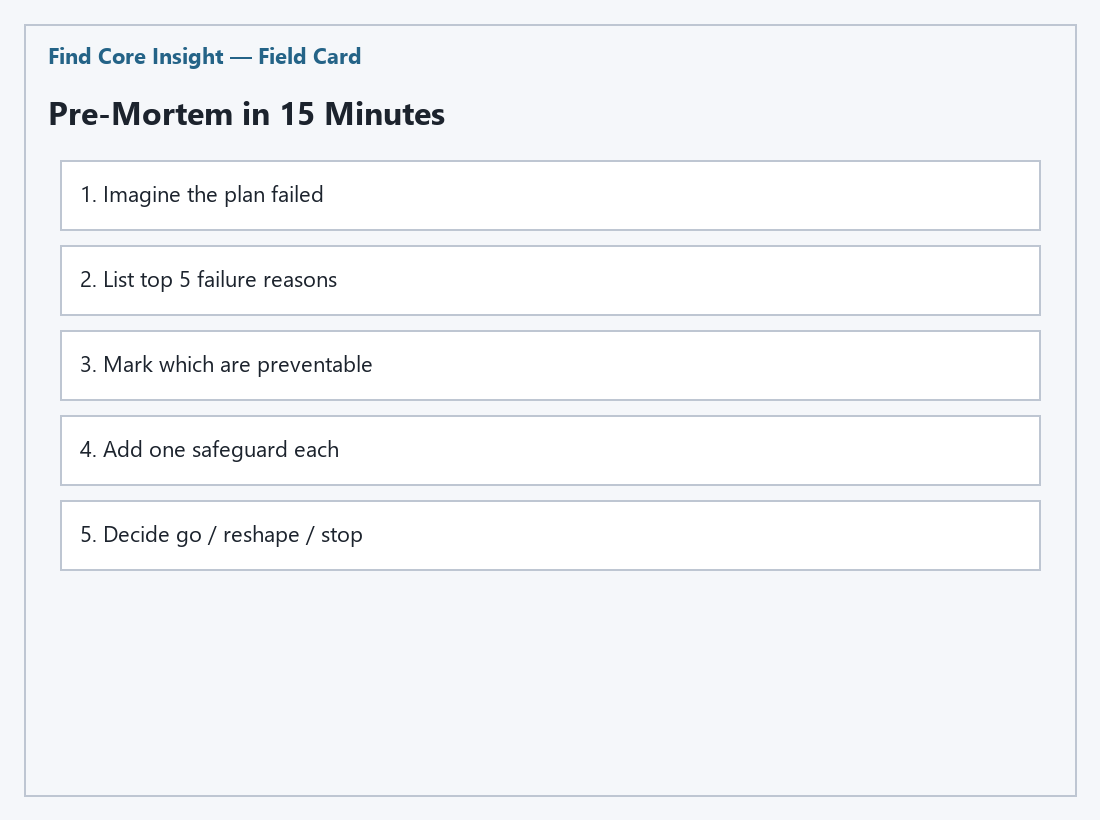
Run a 15-Minute Pre-Mortem Before You Commit. Assume the plan failed and ask why. Fifteen minutes is enough for personal and small-team bets.
When a pre-mortem earns its fifteen minutes
A pre-mortem asks the team to imagine the commitment already failed and name why—before launch, not after blame begins. It earns its time when the choice spends money, calendar, or reputation that is hard to claw back: a cross-team rollout, a customer-facing deadline, a vendor contract, a public FAQ that will be quoted.
Skip it for reversible chores. Running a pre-mortem on every ticket trains people to treat the ritual as theater. Reserve fifteen minutes for commitments where “we will fix it later” is not a credible plan. The goal is not pessimism; the goal is two owned safeguards instead of ten unowned worries.
Concrete nouns beat scary vibes. Vendor replies average five days and we assumed two is usable. Communication might be hard is not. Usable failures become detection signals someone can watch for next Wednesday.
Compare two commitments: reordering the internal wiki and announcing a pricing change to existing customers. Wiki order is reversible and low stakes; a fifteen-minute pre-mortem would feel silly. Pricing touches trust and inbox replies you cannot unsend—fifteen minutes is cheap insurance. Matching ritual weight to undo cost keeps the team from ignoring pre-mortems when they finally matter.
Minute zero through five: silent failure brainstorm
Open with one sentence of context: what we are committing to, by when, and for whom. Then silence. Each person writes failure reasons on sticky notes or a shared doc—no discussion yet. Five minutes only. Quiet people contribute here; loud people cannot filibuster.
Prompt: It is six weeks later and this failed. What happened? Encourage dates, names of dependencies, and handoff gaps—not character attacks. If the room drifts into blame, reset to systems and assumptions.
At minute five, collect without ranking. You should have more items than you can fix. That is correct. The next segment chooses what matters.
For distributed teams, use a shared doc with numbered lines instead of sticky notes. Ask people to duplicate nothing—similar failures will cluster in the next phase. Set a visible timer in the meeting title so nobody negotiates for “just two more minutes” during silence. Silence is the feature; filling it early recreates the loudest-voice problem the pre-mortem is designed to prevent.
Minutes six through ten: cluster and rank
Read failures aloud and cluster similar ones. Merge duplicates aggressively. Then mark each cluster preventable or merely possible. Spend energy on preventable paths—things a checkpoint, owner, or scope cut could catch.
Rank clusters by severity times likelihood, not by who wrote the stickiest note. A boring dependency delay often beats a dramatic market story for teams shipping internal tools. Ask: Which two failures would embarrass us in standup? Circle those.
Stop at two ranked clusters. More than two dilutes ownership. If the team wants twelve mitigations, they are avoiding the hard choice of what to actually watch.
Minutes eleven through fifteen: assign two safeguards
For each top cluster, write one detection signal and one safeguard with a human owner. Detection signals are early warnings: zero signed pilot customers by week two, legal review still unscheduled by Thursday. Safeguards are actions: Wednesday checkpoint owned by Priya, scope cut to one region until export verified.
Reject “try harder” as a safeguard. Reject safeguards with no owner. Photograph the board or paste the two rows into the project note. Close the meeting on time even if someone wants “just one more risk.” The discipline of ending on minute fifteen keeps the ritual credible for the next commitment that actually needs it.
Example: a marketing team pre-mortemed a webinar series. Top failures: low registration and speaker no-shows. Safeguards: registration threshold check ten days out (owner: events), backup speaker confirmed before promotion goes live (owner: content lead). Total time: fourteen minutes. No slide deck required.
Another example: an engineering team launching a read-only API for partners. Failures clustered around rate-limit surprises and unclear deprecation of the old endpoint. Safeguards: load test with partner-like traffic by Wednesday (owner: platform), deprecation banner live two weeks before cutover (owner: docs). Two safeguards, two names, meeting done.
Facilitation moves that keep blame out of the room
Pre-mortems fail when they become performance reviews in disguise. Reset language when you hear “who messed up” by returning to the prompt: systems and assumptions, not heroes and villains. Ask what documentation was missing, which handoff had no owner, which metric was never watched.
If senior leaders dominate minute six, reintroduce silent ranking: everyone gets two votes on sticky dots placed on clusters. Votes reveal perception gaps without forcing the junior engineer to argue with a director live.
Close by reading the two safeguards aloud and asking each owner to confirm out loud. Verbal confirmation takes thirty seconds and prevents “I thought Alex was doing that” two weeks later. Paste the final two rows into the decision log so the pre-mortem survives the meeting memory half-life.
When a safeguard fires later, celebrate the detection—not with a party, but with a one-line retro note: checkpoint caught X; adjusted Y. Teams repeat rituals that visibly saved embarrassment. Teams abandon rituals that feel like theater with no feedback loop.
Invite wording matters: title the calendar block Pre-mortem: [commitment name] and list the three segments in the description. Attendees arrive expecting silence first, not slides. Clear structure reduces the facilitator’s need to improvise under time pressure.
Script for your next non-trivial yes
Before your next commitment that spends trust or public face, block fifteen minutes on the calendar and paste the three-segment script into the invite description. Leave with two safeguards that have names attached—not a longer worry list. Educational workplace content only; not legal, financial, or risk-management advice for regulated decisions.